

AI in Physiotherapy: How Technology Is Changing Rehabilitation
Physiotherapy has always been a hands-on, human-center discipline. Skilled clinicians assess how you move, identify where pain originates, and craft recovery plans built on observation, experience, and touch. That core principle has not changed. What has changed radically, and at speed is the quality and quantity of information available to support those decisions.
Artificial intelligence (AI) is no longer a futuristic concept in healthcare. It is embedded in the clinics, mobile apps, and wearable devices that millions of patients already use for recovery. From AI-powered motion analysis that can detect a 2-degree gait deviation to machine learning algorithms that predict re-injury risk before symptoms appear, technology is giving physiotherapists a level of precision and scale that was simply impossible a decade ago.
In this guide, we explore exactly how AI in physiotherapy works, where it is making the greatest clinical impact, what the evidence says about outcomes, and what patients and practitioners can expect in the years ahead. Whether you are a patient researching your recovery options, a clinician evaluating new tools, or simply curious about the future of rehabilitation, this article covers everything you need to know.
1. What Does ‘AI in Physiotherapy’ Actually Mean?
The term ‘AI in physiotherapy’ covers a broad spectrum of technologies. At its simplest, it refers to using computer algorithms trained on patient data to support clinical tasks that would normally require significant time, expertise, or physical presence. In practice, this includes:
- Machine learning models that analyze movement patterns or medical records to generate personalized rehabilitation programs.
- Computer vision systems that track body position in real time via a smartphone camera or dedicated sensor, correcting exercise form without a therapist present.
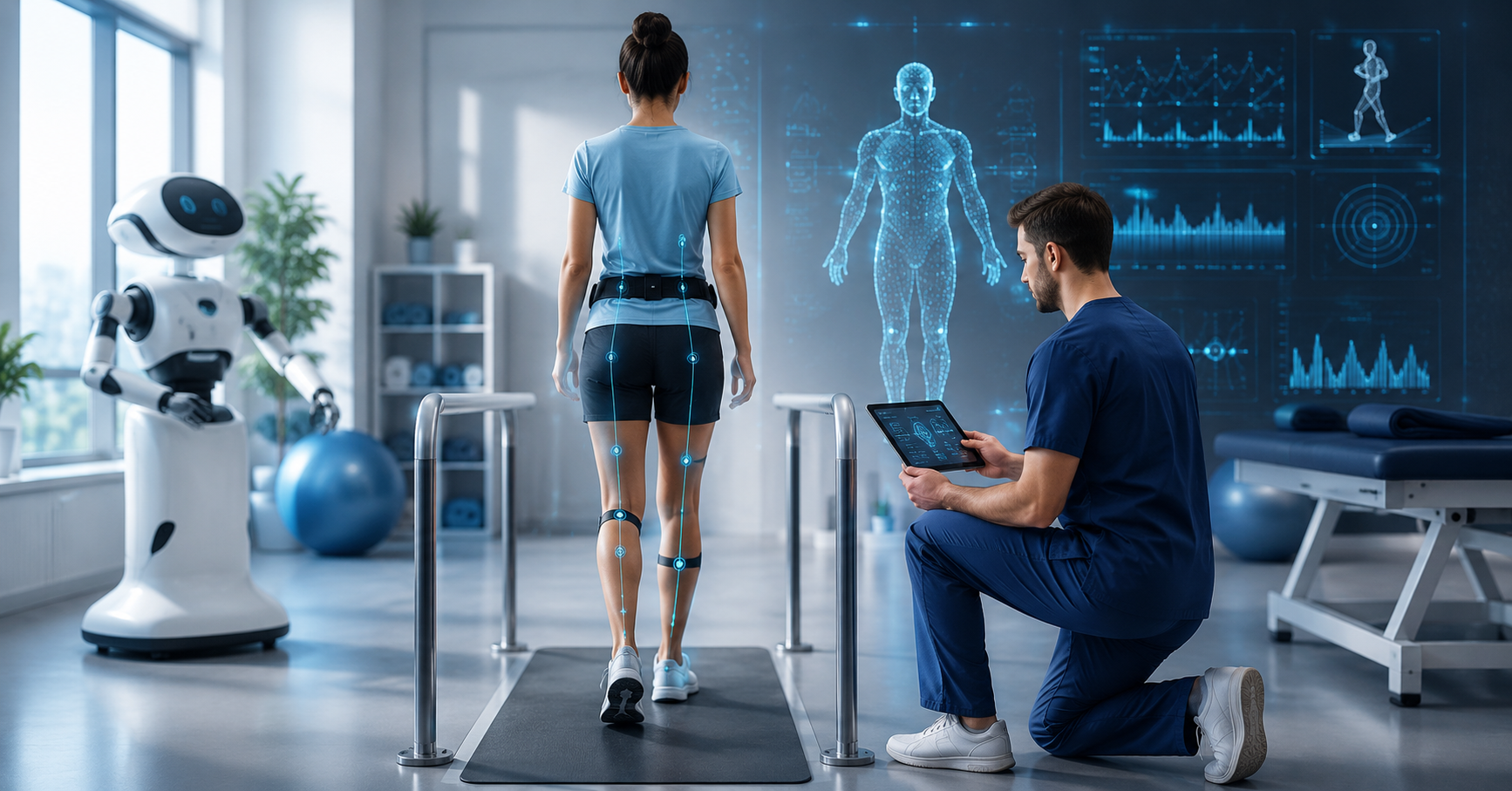
- Wearable sensors that continuously capture biomechanical data, joint angles, muscle activation, gait speed and transmit it to a clinician dashboard.
- Natural language processing (NLP) tools that automate clinical documentation, reducing the administrative burden on physiotherapists by up to 70%.
- Predictive analytics platforms that use demographic data, injury history, and sensor readings to forecast recovery timelines and flag patients at risk of non-adherence or re-injury.
Importantly, AI is not a single product. It is a capability layer that can be embedded into hardware (exoskeletons, robotic devices), software (telerehabilitation platforms, EMR systems), and consumer tools (apps and wearables). Understanding this distinction matters because the clinical evidence and the clinical risk varies significantly across these categories.
2. AI-Powered Motion Analysis: Seeing Movement with New Eyes
One of the most impactful applications of AI in physiotherapy is movement analysis. Traditional gait and posture assessment depends on a clinician’s trained eye, a skill that takes years to develop and is inherently subjective. AI is beginning to change this.
How AI Motion Analysis Works
AI-powered motion analysis uses computer vision, deep learning models, and biomechanical simulations to assess gait, posture, and musculoskeletal function. Systems trained on thousands of movement samples can now detect compensatory patterns, subtle asymmetries, and early signs of fatigue that are difficult to perceive with the naked eye.
Platforms like Kaia Health’s Motion Coach use a smartphone’s front-facing camera to track the position of anatomical landmarks, shoulders, hips, knees, ankles and compare the patient’s movement to a validated model of correct technique. Feedback is instant: ‘straighten your knee’ or ‘keep your core engaged’. This is AI acting as an always-available movement coach.
Clinical Evidence for AI Motion Analysis
The clinical outcomes are compelling. A study published in Frontiers in Sports and Active Living found that AI-driven motion analysis improved rehabilitation efficiency by 40% compared to traditional assessments, with patients recovering faster when interventions were adjusted in real time using AI-based movement tracking.
Researchers at the University of Idaho have developed deep learning frameworks for the automated assessment of rehabilitation performance, training convolutional neural networks (CNNs) and recurrent neural networks (RNNs) to generate objective movement quality scores. This kind of standardization removes inter-rater variability a long-standing challenge in clinical physiotherapy.
3. Wearable Technology and Smart Sensors: Real-Time Data for Better Outcomes
Wearable technology for physical therapy is one of the fastest-growing segments in digital health. Devices embedded with AI-driven sensors now collect real-time kinematic, electromyographic (EMG), and force data, allowing objective, continuous assessment of muscle activity and joint function without the patient ever needing to visit a clinic.
What Wearable Sensors Actually Measure
Modern rehabilitation wearables go far beyond step counting. Depending on the device and clinical use case, AI-enabled wearables can capture:
- Joint range of motion (ROM) in degrees, updated continuously throughout an exercise session.
- Electromyography (EMG) signals that reveal which muscles are firing and how hard giving insight into compensation patterns.
- Inertial measurement unit (IMU) data for gait speed, cadence, step symmetry, and balance.
- Ground reaction forces via sensor-embedded insoles, critical for post-surgical weight-bearing protocols.
- Heart rate variability (HRV) and fatigue indicators that signal when to modify exercise intensity.
Devices like SWORD Health’s wireless motion trackers, ReFlex by Reflexion Health, and BioSensics wearables provide instant feedback on movement and muscle activation. SWORD Health’s system which uses a ‘digital therapist’ model has demonstrated particularly strong outcomes: in a clinical study of patients recovering from knee injuries, the SWORD group achieved Timed Up and Go scores twice as good as those following conventional physiotherapy.
AI-Enabled Balance and Neurological Rehabilitation
AI-assisted balance training is showing impressive results for neurological conditions. Studies show that AI-assisted balance training improves postural stability by 37% in stroke and Parkinson’s disease patients, according to research published in Neuroscience & Biobehavioral Reviews. For patients with conditions including multiple sclerosis, AI systems can recognise abnormal movement patterns during functional tasks and adjust the rehabilitation programme dynamically.
4. Robotic-Assisted Therapy: Machines That Learn from Every Patient
Robotic rehabilitation represents perhaps the most visible frontier of AI in physiotherapy. Robots equipped with machine learning algorithms can now customize physiotherapy regimens targeting specific deficits in strength, flexibility, or motor coordination and they get better at it over time.
How Rehabilitation Robots Work
AI-powered rehabilitation robots use real-time sensor feedback to enable adaptive exercise modifications that respond to patient progress or fatigue levels. As the patient gains strength and ability, the robot progressively reduces its assistance, encouraging greater independent effort. This ‘assist-as-needed’ model, grounded in neuroplasticity research, accelerates motor learning more effectively than passive robotic guidance.
Exoskeleton devices integrate soft pneumatic actuators driven by AI algorithms to support joint movements, aiding recovery of limbs impaired by injury or surgery. Companies like Bionik Labs have developed mechanical rehabilitation devices for hands, wrists, and arms that process vast amounts of data, becoming progressively ‘smarter’ about each patient’s capabilities.
Evidence for Robotic Therapy Outcomes
The evidence base is growing rapidly. A study published in Stroke Journal found that AI-powered exoskeletons improved walking speed by 50% in post-stroke patients compared to conventional therapy. VR-assisted therapy augmented by AI increased functional recovery by 35% in the same population. These are not marginal improvements they represent a step change in what rehabilitation can achieve.
For neurological physiotherapy specifically, AI-enabled robotic systems are being investigated for conditions including epilepsy, Parkinson’s disease, Alzheimer’s disease, multiple sclerosis, and ischaemic stroke. Computer-aided diagnosis (CAD) systems using AI and modern signal processing methods are helping clinicians analyze physiological signals and images with a precision that was previously only achievable in highly specialized research settings.
5. Telerehabilitation and AI Virtual Physiotherapy: Care Without Boundaries
Telerehabilitation was accelerated by necessity during the COVID-19 pandemic, but AI has transformed it from a compromise solution into a clinically credible model of care. AI-driven telerehabilitation platforms now use computer vision, AI-based exercise coaching, and chatbots to provide real-time physiotherapy sessions remotely with outcomes that increasingly rival in-person care.
How AI Powers Virtual Physiotherapy
AI virtual physiotherapy assistants (VPAs) combine wearable sensors, computer vision from smartphone cameras, and adaptive algorithms to guide patients through rehabilitation exercises at home. They monitor form, count repetitions, detect errors, adjust intensity based on performance, and send progress reports to the supervising physiotherapist.
Platforms like SWORD Health, Kaia Health, and Physera use AI-driven exercise correction algorithms to guide patients outside the clinic. Home-based rehab supported by these systems has been shown to increase patient engagement and adherence by up to 60%, according to research published in BMJ Digital Health. When patients actually do their exercises correctly outcomes improve dramatically.
Telerehabilitation Outcomes: What the Research Shows
A study in The Lancet Digital Health found that AI-powered telerehabilitation led to a 32% increase in treatment adherence and a 25% faster recovery rate compared to traditional home exercise programs. These numbers matter enormously at scale: poor adherence to home exercise programs is one of the single largest causes of slow or incomplete recovery in physiotherapy.
AI-driven VPAs are also expanding access in geographically underserved areas. For patients in rural India, remote Australia, or anywhere with limited physiotherapy infrastructure, a smartphone-based AI rehabilitation platform can provide a level of guided, personalized care that was previously unavailable.
6. Predictive Analytics: Getting Ahead of Injury and Setback
Perhaps the most profound shift AI brings to physiotherapy is the move from reactive to proactive care. Rather than waiting for a patient to report pain or plateau, predictive analytics models can identify warning signs in the data weeks before clinical deterioration occurs.
AI for Injury Risk Assessment
Machine learning models analyze integrated datasets encompassing demographics, gait biomechanics, fatigue indicators, previous injury history, and real-time sensor readings to generate personalized injury risk scores. Wearables equipped with AI algorithms can detect subtle deviations in gait, posture, and muscular activation that signal recovery stage changes or risk of relapse.
In sports physiotherapy, AI tools are being used to analyze data from athlete performance monitoring to predict injury risks and implement preventive strategies. This is particularly valuable in elite sport, where the cost of a missed training block or competition absence is substantial but the same logic applies to an older adult recovering from hip surgery where a fall or re-injury could be catastrophic.
Predicting Recovery Timelines
Through multivariable prediction models, AI can analyze complex patient data to predict long-term recovery outcomes. This is especially valuable for post-surgical rehabilitation AI models predicting post-injury complications have been shown to improve recovery rates by 27% and reduce hospital readmissions, according to a study in JAMA Network Open (2023).
For physiotherapy clinics and healthcare systems, the operational value of accurate recovery prediction is equally significant. Knowing which patients are likely to need additional sessions, struggle with home exercise adherence, or face a heightened re-injury risk allows clinicians to allocate time and resources far more effectively.
7. Personalized Rehabilitation Programs: The End of One-Size-Fits-All
Traditional physiotherapy rehabilitation protocols are largely population-based — a set of exercises drawn from clinical guidelines for a given condition, adjusted through trial and error as the therapist observes the patient’s progress. AI is enabling a fundamentally different model: programs that are individualized from the outset and continuously adapt based on real-time data.
Machine learning algorithms create tailored rehabilitation programs by analyzing medical records, treatment responses, biomechanical data, and patient-reported outcomes, leading to improved patient compliance and more effective clinical decision-making. The continuous feedback loops built into these systems allow treatment plans to adapt as the patient’s condition changes, strengthening the therapeutic relationship and enhancing satisfaction.
PhysioAI software, used in some US clinics, offers instant recommendations for modifying the intensity or nature of exercises based on live biometric data. This keeps patients engaged while maximizing outcomes addressing one of the most common failure modes in rehabilitation: the mismatch between what a protocol prescribes and what an individual patient’s body can actually tolerate on any given day.
8. AI in Physiotherapy Diagnosis: Faster, More Accurate Assessment
Clinical diagnosis in physiotherapy is complex. Pain is subjective, movement patterns are multifactorial, and the relationship between structural findings on imaging and a patient’s functional limitations is often inconsistent. AI is beginning to address some of these diagnostic challenges.
AI for Musculoskeletal Diagnosis
AI systems are transforming physiotherapy by offering unprecedented precision in patient assessment and treatment planning. Machine learning models trained on large datasets of clinical examinations, imaging, and outcomes data can flag diagnostic possibilities that even experienced clinicians might miss particularly in complex presentations involving multiple structures.
In orthopedic physiotherapy, AI has been applied to hip fracture detection with strong results: a systematic review and meta-analysis published in JAMA Network Open (2023) found that AI models for hip fracture detection achieved diagnostic accuracy comparable to specialist radiologists. The same class of algorithm is being developed for other common musculoskeletal conditions including rotator cuff pathology, knee osteoarthritis staging, and lumbar disc assessment.
AI for Neurological Assessment
Computer-aided diagnosis (CAD) systems using AI and modern signal processing methods can help clinicians in analyzing and interpreting physiological signals and images more effectively in neurological disorders. AI sensors can recognize abnormal movement patterns during functional movements and can be of great value in the analysis of functional tasks and the prescription of personalized treatment plans for patients with conditions including Parkinson’s disease, stroke, and multiple sclerosis.
9. Benefits and Challenges of AI in Physiotherapy
The Key Benefits
- Enhanced diagnostic precision: AI reduces inter-rater variability and flags subtle clinical signs that human observation might miss.
- Truly personalized care: Treatment programs that adapt in real time to individual patient data, not population averages.
- Greater accessibility: Telerehabilitation powered by AI brings high-quality physiotherapy to patients in remote, underserved, or mobility-restricted situations.
- Better adherence: Real-time feedback, gamification, and progress tracking dramatically improve patient engagement with home exercise programs.
- Predictive capability: Identifying at-risk patients before complications arise, reducing re-injury rates and unnecessary readmissions.
- Operational efficiency: AI documentation tools, scheduling optimization, and prior authorization automation free clinicians to focus on patient care.
The Challenges That Must Be Addressed
The benefits are real, but so are the challenges. A balanced assessment of AI in physiotherapy must acknowledge:
- Data privacy and security: AI systems handle sensitive patient health data, raising important questions about GDPR, HIPAA compliance, informed consent, and data sovereignty.
- Algorithmic bias: AI models trained on datasets that lack demographic diversity can produce biased outputs a particular concern in conditions where disease presentation differs across age, sex, or ethnicity.
- Clinical evidence gaps: A systematic review of 9,054 articles identified only 5 randomized controlled trials testing AI-supported rehabilitation technology. While results were positive, the evidence base remains thin relative to the pace of adoption.
- Integration and workflow: Embedding AI tools into existing clinical workflows, electronic health records, and reimbursement systems remains logistically complex.
- The irreplaceable human element: Physiotherapy involves therapeutic alliance, emotional support, and tactile assessment — dimensions of care that AI cannot replicate. Over-reliance on automated systems risks eroding what makes physiotherapy effective.
10. Will AI Replace Physiotherapists?
This is the question that generates most anxiety and most discussion. The short answer, based on current evidence and the nature of physiotherapy, is: no.
AI is designed to support physiotherapists, not substitute them. Human expertise, hands-on treatment, tactile assessment, therapeutic alliance, and the clinical reasoning that contextualizes data within a patient’s lived experience remain essential for effective rehabilitation. What AI does is extend the reach, precision, and efficiency of the physiotherapist.
Professor Michael Rowe of Open Physio Journal frames the challenge well: physiotherapy education needs to adapt to ‘deepen and strengthen the human-based components that are difficult for AI-based systems to replicate, while integrating the technological and data literacies needed to work with smart machines.’ This is not a competition between humans and machines. It is an evolution in what it means to practice evidence-based physiotherapy.
The physiotherapists who will thrive in an AI-augmented healthcare environment are those who understand how to interpret AI-generated data, critically evaluate algorithmic recommendations, and maintain the relational skills that no algorithm can provide. AI literacy is fast becoming a core clinical competency.
11. The Future of AI in Physiotherapy: What’s Coming Next
The trajectory of AI in physiotherapy points toward several transformative developments over the coming years:
- Federated learning models: AI systems that can learn from patient data across multiple institutions without centralizing sensitive records — addressing privacy concerns while enabling more diverse, generalizable training datasets.
- Smart garments and sensor-embedded exoskeletons: Rehabilitation wearables that are more ergonomic, energy-efficient, and affordable, removing the cost barrier to continuous monitoring.
- AI + EMG/EEG integration for neuro-rehabilitation: Deeper integration of electrophysiological signals with movement data to support recovery in complex neurological conditions.
- Autonomous rehabilitation robots: AI-driven robotic assistants capable of conducting high-intensity rehabilitation sessions with minimal therapist supervision, expanding clinic capacity.
- AI self-assessment tools: Consumer-facing applications that enable early detection of musculoskeletal dysfunction potentially intercepting conditions before they become chronic.
- IoT-connected rehabilitation ecosystems: Wearables, home sensors, clinic equipment, and electronic health records forming a connected data environment that enables truly holistic, longitudinal patient management.
The global rehabilitation technology market is projected to grow substantially through the late 2020s, driven by ageing populations, rising chronic disease burden, and growing evidence of digital health’s cost-effectiveness. For physiotherapy specifically, AI is not a niche add-on, it is becoming the infrastructure through which modern rehabilitation is delivered.
12. How The Fysit Integrates Technology into Rehabilitation
At The Fysit, we believe the future of physiotherapy is neither purely digital nor purely manual it is intelligently blended. Our clinicians combine the evidence-based precision of AI-assisted assessment with the irreplaceable value of human therapeutic care.
We use technology-enhanced movement analysis to support diagnosis and track progress with greater objectivity. We offer telerehabilitation options for patients who benefit from remote monitoring, home-based exercise guidance, and between-session accountability. And we continuously evaluate emerging AI tools against the evidence, adopting those that genuinely improve outcomes for our patients.
If you are curious about how technology could support your rehabilitation journey whether you are recovering from surgery, managing a chronic condition, or working on injury prevention our team is here to help you navigate the options.
Frequently Asked Questions: AI in Physiotherapy
Q: How is AI used in physiotherapy?
AI is used in physiotherapy for movement analysis, personalized treatment planning, wearable-based real-time monitoring, robotic-assisted therapy, telerehabilitation, predictive injury risk assessment, and automated clinical documentation. It supports physiotherapists in delivering more precise, personalized, and accessible care.
Q: Can AI replace a physiotherapist?
No. AI cannot replace the diagnostic reasoning, tactile assessment, therapeutic alliance, and emotional support that are central to effective physiotherapy. AI is a clinical tool that enhances what physiotherapists can do it is not a substitute for human expertise. The best rehabilitation outcomes come from combining skilled human care with intelligent technology.
Q: What are the best AI tools for physiotherapists?
Leading AI tools in physiotherapy include SWORD Health’s wireless motion tracking system for home-based rehabilitation, Kaia Health’s Motion Coach for app-based exercise correction, PhysioAI for adaptive treatment planning, and a growing range of wearable platforms including ReFlex and BioSensics devices. EMR-integrated AI tools for documentation and prior authorization are also gaining traction.
Q: Does AI-powered physiotherapy produce better outcomes?
Emerging evidence is positive. Studies show AI-assisted physiotherapy can improve rehabilitation efficiency by up to 40%, increase treatment adherence by 32%, and reduce recovery time by 25% compared to standard home exercise programs. AI-powered exoskeletons have improved walking speed by 50% in stroke patients in some trials. However, the evidence base is still developing most strong results come from early clinical trials, and real-world implementation data is still being gathered.
Q: Is AI physiotherapy safe?
When implemented responsibly, AI physiotherapy tools have a strong safety profile. The main risk areas are data privacy (ensuring GDPR/HIPAA-compliant handling of health data), algorithmic accuracy (ensuring AI outputs are validated before informing clinical decisions), and over-reliance on automated systems without appropriate clinical oversight. Reputable platforms address these through transparent validation studies, regulatory compliance, and maintaining the physiotherapist as the clinical decision-maker.
Q: What is telerehabilitation and how does AI improve it?
Telerehabilitation refers to the delivery of rehabilitation services remotely, typically via apps, video calls, and digital exercise platforms. AI improves telerehabilitation by providing real-time movement feedback via computer vision, adapting exercise programs based on patient performance data, tracking adherence, and enabling physiotherapists to monitor multiple patients simultaneously through automated dashboards. This makes remote physiotherapy more clinically effective and scalable.
Ready to Experience the Future of Physiotherapy?
At The Fysit, we combine the precision of the latest rehabilitation technology with the care and expertise of our physiotherapy team. Whether you need in-person treatment or prefer the flexibility of our online physiotherapy service, we are here to help you recover faster, move better, and stay injury-free.