


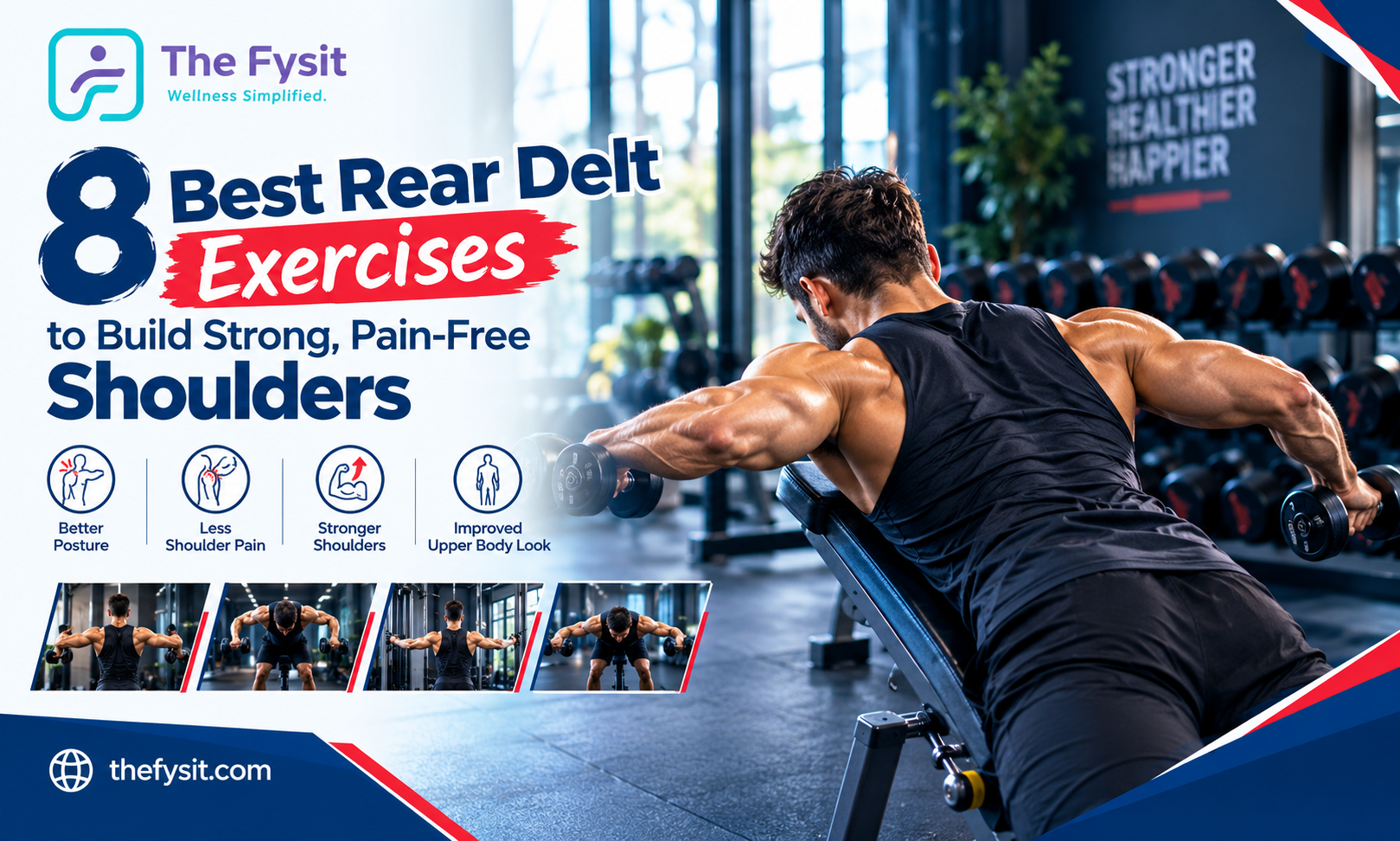
8 Best Rear Delt Exercises to Build Strong, Pain-Free Shoulders
If you train your chest and the front of your shoulders more than your upper back, your shoulders may be paying the price. Many people notice a rounded posture, a tight neck, or a dull ache at the back of the shoulder, and the real problem is often weak rear delts.
The good news is that rear delt exercises are simple to learn, need very little equipment, and can be done at home or in the gym. In this guide, our physiotherapists at The Fysit explain what the rear delts do, how to know if yours are weak, and the 8 best exercises to strengthen them safely. You will also find a ready-to-use weekly plan, common mistakes to avoid, and tips on when to see a physiotherapist.
What Are Rear Delts?
Your shoulder is covered by a large muscle called the deltoid. It has three parts: the front (anterior), the middle (lateral), and the back (posterior). The back part is what we call the rear delt, or posterior deltoid.
It starts from the spine of your shoulder blade and attaches to the upper arm bone. Its main jobs are:
- Moving your arm backward, like when you reach back to pick up a bag from the back seat of a car
- Pulling your arm out to the side when it is bent forward
- Helping your shoulder rotate outward
- Keeping the shoulder joint steady during pulling and lifting
The rear delt is a small muscle, but it works closely with the muscles around your shoulder blade, such as the rhomboids, the middle trapezius, and the rotator cuff. When all of them are strong, your shoulder moves smoothly. When the rear delt is weak, the other muscles have to work harder, and that is when strain and pain start.
Why Rear Delt Exercises Matter
Most of our daily life and gym routines are front-heavy. Typing, driving, scrolling on the phone, and even popular exercises like push-ups and the bench press all work the front of the body. Over time, the front of the shoulder becomes strong and tight, while the back becomes weak and stretched.
Here is why training the rear delts is worth your time:
Better posture. Strong rear delts help pull the shoulders back and keep them from rolling forward. This is especially useful if you sit at a desk for long hours.
Healthier shoulder joints. A balanced shoulder is less likely to get irritated during overhead movements, pressing, or throwing.
Better performance. A strong back of the shoulder improves your pulling strength, which helps in rows, pull-ups, swimming, cricket, badminton, and many other activities.
Fuller, more balanced shoulders. If you train for looks, rear delts add width and shape when seen from the side and back.
Signs Your Rear Delts May Be Weak
You do not need a test to find out. Watch for these common signs:
- Your shoulders sit forward or look rounded when you stand relaxed
- You feel tired or achy between the shoulder blades after sitting for a while
- You get a pinching feeling at the front of the shoulder during pressing
- Your upper back feels stiff, and your neck feels tight by the end of the day
- Pulling movements like rows feel much harder than pushing movements
If you notice several of these, adding rear delt work to your routine can help. If the pain is sharp or keeps getting worse, please get it checked by a physiotherapist first.
Before You Start: Quick Safety Tips
- Warm up for 5 to 7 minutes with arm circles, shoulder rolls, and light band work
- Start with light weights. The rear delt is a small muscle and does not need heavy loads to work
- Move slowly and avoid swinging your body to lift the weight
- Stop if you feel sharp pain, pinching, tingling, or numbness
- If you have a past shoulder injury, surgery, or ongoing pain, speak to a physiotherapist before starting
The 8 Best Rear Delt Exercises
- Bent-Over Dumbbell Reverse Fly
This is the classic rear delt exercise and a great starting point.
Equipment: a pair of light dumbbells
How to do it:
- Stand with your feet shoulder-width apart and a slight bend in your knees.
- Hinge forward from your hips until your back is almost parallel to the floor. Keep your back straight.
- Let your arms hang down with your palms facing each other and a soft bend in your elbows.
- Lift both arms out to the sides until they reach shoulder height, as if you are opening your wings.
- Pause for a second, then lower slowly.
Sets and reps: 3 sets of 12 to 15 reps
Physio tip: Imagine pushing your hands apart rather than lifting them up. This keeps the work in your rear delts and not your neck.
- Face Pull
The face pull is one of the most useful shoulder exercises for people who sit a lot. It works the rear delts and the muscles that rotate the shoulder outward.
Equipment: cable machine with a rope, or a resistance band tied at face height
How to do it:
- Set the cable or band at about eye level and hold the rope with both hands, palms facing in.
- Step back so your arms are straight in front of you.
- Pull the rope toward your face, spreading your hands apart as you pull.
- Keep your elbows high and finish with your hands beside your ears.
- Squeeze your shoulder blades together, then return slowly.
Sets and reps: 3 sets of 12 to 15 reps
Physio tip: Keep your ribs down and do not lean back. If your lower back arches, the weight is too heavy.
- Reverse Pec Deck (Rear Delt Machine)
If your gym has this machine, it is one of the easiest ways to isolate the rear delts because the machine guides the movement for you.
How to do it:
- Sit facing the pad with your chest supported against it. Adjust the seat so the handles are at shoulder height.
- Hold the handles with your arms almost straight.
- Move your arms backward in a wide arc until your hands are in line with your shoulders.
- Hold for one to two seconds, then return slowly.
Sets and reps: 3 sets of 10 to 15 reps
Physio tip: Do not let the weight stack drop at the end of each rep. The slow return is where a lot of the strength is built.
- Band Pull-Apart
This is the best rear delt exercise for home. All you need is a resistance band, and it takes less than two minutes.
Equipment: resistance band
How to do it:
- Hold the band in front of you at chest height with your hands about shoulder-width apart and your arms straight.
- Pull the band apart by moving your hands out to the sides.
- Stop when the band touches your chest or your arms are in a straight line with your shoulders.
- Return slowly.
Sets and reps: 3 sets of 15 to 20 reps
Physio tip: Keep your shoulders down and away from your ears. Pick a lighter band if your shoulders shrug up.
- Incline Bench Reverse Fly
Lying face down on an incline bench supports your body, so you can focus fully on the rear delts without worrying about your lower back.
Equipment: incline bench and light dumbbells
How to do it:
- Set the bench at a 30 to 45 degree angle and lie face down with your chest on the pad.
- Let your arms hang straight down, holding the dumbbells with palms facing each other.
- Lift your arms out to the sides until they are level with your shoulders.
- Lower under control.
Sets and reps: 3 sets of 12 to 15 reps
Physio tip: Keep your head relaxed and in line with your spine. Looking up strains the neck.
- Prone Y-T-W Raises
This is a great bodyweight option that trains the rear delts along with the muscles around the shoulder blades. It is often used in physiotherapy because it is gentle and effective.
Equipment: none (add very light dumbbells later)
How to do it:
- Lie face down on the floor or a bed with your forehead resting on a folded towel.
- For the Y: raise both arms overhead in a Y shape with thumbs pointing up, lift a few inches off the floor, hold, and lower.
- For the T: place your arms straight out to the sides in a T shape, lift, hold, and lower.
- For the W: bend your elbows into a W shape, lift, squeeze your shoulder blades, and lower.
Sets and reps: 2 rounds of 8 to 10 reps for each letter
Physio tip: The movement is small. Lifting just a few inches with good control is better than lifting high with a shaky arm.
- Wide-Grip Seated Cable Row
Rows work many muscles at once, and a wide grip shifts more of the effort to the rear delts and upper back.
Equipment: cable row machine with a straight bar or wide handle
How to do it:
- Sit tall with your knees slightly bent and hold the bar with a wide, overhand grip.
- Pull the bar toward your upper stomach, letting your elbows flare out to the sides.
- Squeeze your shoulder blades together at the end.
- Return slowly until your arms are straight, without letting your shoulders round forward.
Sets and reps: 3 sets of 10 to 12 reps
Physio tip: Avoid leaning far back to finish the pull. Your body should stay tall throughout.
- Side-Lying External Rotation
This one is less about heavy lifting and more about shoulder control. It strengthens the rear delt along with the small rotator cuff muscles that keep your shoulder joint stable.
Equipment: a very light dumbbell (or a water bottle) and a small rolled towel
How to do it:
- Lie on your side with your elbow bent at 90 degrees and your upper arm resting against your body. Place the rolled towel between your elbow and your waist.
- Hold the weight and, keeping the elbow pinned to the towel, rotate your forearm upward toward the ceiling.
- Pause, then lower slowly.
Sets and reps: 2 to 3 sets of 12 to 15 reps on each side
Physio tip: Use a very light weight. This muscle group is small, and good form matters more than load.
Sample Weekly Rear Delt Plan
You do not need a separate shoulder day. Two to three short sessions a week are enough for most people.
Beginner (home-based): Do band pull-aparts, prone Y-T-W raises, and side-lying external rotations on two days a week. Rest at least one day in between.
Intermediate (gym or home with dumbbells): Pick any three exercises from the list, such as bent-over reverse fly, face pulls, and incline bench reverse fly. Do them two to three times a week at the end of your upper-body workout.
Advanced: Add the reverse pec deck and wide-grip cable row, and slowly increase the weight or reps every one to two weeks.
A simple rule: when you can complete all your sets and reps with perfect form, add a little more weight or a few more reps. Do not rush it.
Common Mistakes to Avoid
Using weights that are too heavy. This is the most common mistake. Heavy weights make you swing your body and use your neck and lower back instead of your rear delts.
Shrugging your shoulders. If your shoulders rise toward your ears, your upper trapezius is taking over. Keep your shoulders down and relaxed.
Rushing the reps. Fast, jerky reps reduce the muscle work. Lift in about two seconds and lower in about three.
Ignoring the rest of the shoulder. Rear delts work best when the shoulder blade muscles and rotator cuff are also strong. Mix in rows and rotation work for complete shoulder health.
Training through pain. Muscle fatigue is normal. Sharp, pinching, or radiating pain is not. Stop and get advice.
When Should You See a Physiotherapist?
Exercise helps most shoulder weakness, but some symptoms need a proper assessment. Please book a visit if you notice:
- Shoulder pain that lasts more than two weeks
- Pain at night or when lifting your arm overhead
- A clicking, catching, or pinching feeling during movement
- Weakness or reduced range of motion after an injury
- Tingling or numbness in the arm or hand
A physiotherapist can find out whether the problem comes from weak muscles, poor posture, a tight neck, or an injury, and give you a plan that fits your body and lifestyle.
Strengthen Your Shoulders with The Fysit
At The Fysit, our physiotherapists help people of all ages recover from shoulder pain, improve posture, and return to sports and everyday activities with confidence. Whether you are an office professional dealing with a stiff upper back or an athlete who wants stronger shoulders, we build exercise plans that match your needs.
You can visit us at our clinics in Kasturi Nagar, Sadanandanagar, and Brookefield in Bangalore. Book an appointment today and take the first step toward stronger, pain-free shoulders.
Conclusion
Rear delt exercises are a small addition to your routine with a big payoff. They improve posture, protect your shoulder joints, and help you move and lift better. Start with two or three exercises from this list, use light weights, focus on slow and controlled movement, and build up gradually. Stay consistent for a few weeks, and you will feel the difference in how your shoulders move and sit.
If you are unsure where to begin or already have shoulder pain, a physiotherapist can guide you safely.
Disclaimer: This article is for general information and is not a substitute for professional medical advice. Please consult a qualified physiotherapist or doctor before starting a new exercise program, especially if you have pain or an existing injury.
Frequently Asked Questions
What are the best rear delt exercises for beginners?
Band pull-apart, bent-over dumbbell reverse flies with light weights, and prone Y-T-W raises are the best starting points. They are easy to learn and put very little stress on the joints.
How often should I train my rear delts?
Two to three times a week is enough for most people. The rear delts recover quickly, so short and regular sessions work better than one long session.
Can I train rear delts at home without equipment?
Yes. Prone Y-T-W raises and side-lying external rotations need no equipment. A simple resistance band opens up many more options, such as band pull-aparts and band face pulls.
How many reps and sets should I do for rear delts?
Most people do well with 2 to 3 sets of 12 to 15 reps. Choose a weight that feels challenging in the last few reps but still lets you keep good form.
Why can’t I feel my rear delts working?
This usually happens because the weight is too heavy or the traps and neck are taking over. Lower the weight, keep your shoulders down, move slowly, and focus on pushing your hands apart.
Do rear delt exercises help with posture?
Yes. Strong rear delts and upper back muscles help pull the shoulders back and reduce the rounded-shoulder look that comes from long hours of sitting. They work best when combined with regular movement breaks and good desk habits.
Are rear delt exercises safe if I have shoulder pain?
It depends on the cause of the pain. Some gentle exercises can help, but the wrong movement can make certain injuries worse. It is best to get assessed by a physiotherapist before you begin.


