



Cartilage vs Ligament: What’s the Difference and Why Does It Matter?
If you’ve ever heard a doctor or physiotherapist mention “cartilage damage” or a “ligament tear” and wondered whether these are actually the same thing, you’re not alone. Cartilage and ligaments are both connective tissues found around our joints, and because they’re often mentioned in the same breath – especially after a sports injury or a twisted knee – it’s easy to assume they do the same job. They don’t.
Understanding the difference between cartilage and ligament isn’t just a matter of medical trivia. It actually matters for how an injury is assessed, how it’s likely to behave, and what kind of rehabilitation approach might be appropriate. This article breaks down what each of these tissues actually is, how they differ, and how physiotherapy can play a role when either one is injured.
What Is Cartilage?
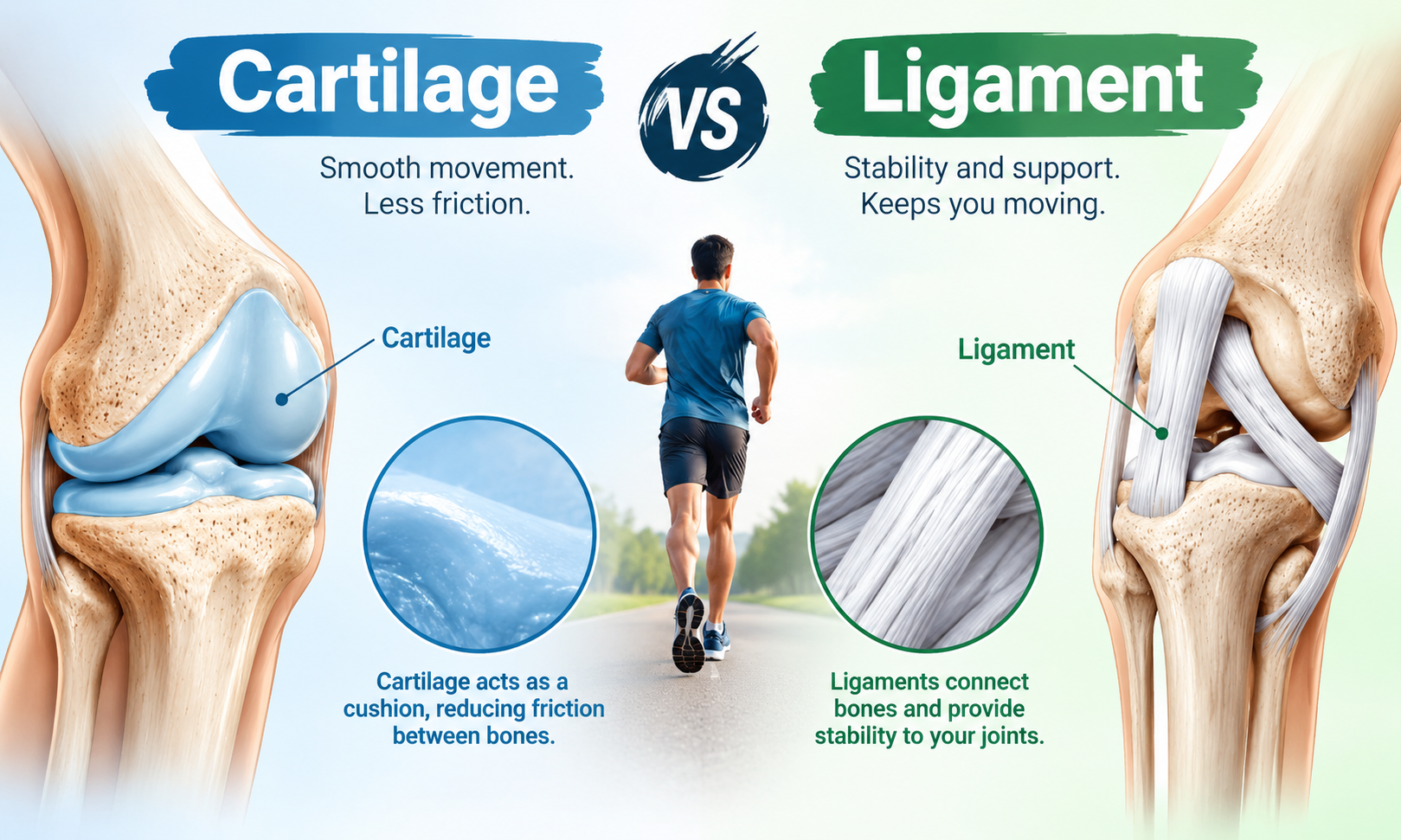
Cartilage is a smooth, flexible connective tissue found in various parts of the body, most notably at the ends of bones where they meet to form a joint. Unlike bone, cartilage doesn’t contain nerves or a direct blood supply in most areas, which gives it a distinctive, somewhat rubbery texture that allows it to absorb shock and reduce friction.
There are a few different types of cartilage in the body, but the type most relevant to joint health is the smooth cartilage that lines the ends of bones (often called articular cartilage), along with specialized structures like the meniscus in the knee, which acts as a cushioning pad between the thigh bone and shin bone.
What Does Cartilage Do?
Cartilage’s main role is to allow bones to glide smoothly against each other during movement, while also absorbing and distributing the forces that pass through a joint. Think of it as a natural cushioning system – without it, bone would essentially rub against bone, which would be both painful and damaging over time.
Because cartilage has a limited blood supply, it also has a relatively slow capacity to repair itself compared to many other tissues in the body. This is one of the key reasons cartilage-related issues are often approached differently from other joint problems.
What Is a Ligament?
Ligaments are tough, fibrous bands of connective tissue that connect one bone to another. Unlike cartilage, which cushions the ends of bones, ligaments act more like strong ropes or straps that hold bones together and keep joints stable during movement. You’ll find ligaments around nearly every joint in the body, but some of the more commonly discussed ones include the anterior cruciate ligament (ACL) in the knee, the ligaments around the ankle, and those supporting the shoulder joint.
What Does a Ligament Do?
A ligament’s primary job is to provide stability. It limits how far a joint can move in certain directions, preventing excessive or abnormal motion that could otherwise lead to injury. For example, the ligaments around your ankle help stop your foot from rolling too far inward or outward, while the ligaments in your knee help control forward, backward, and rotational movement of the joint.
Ligaments do have some blood supply, generally more than cartilage, though it varies depending on the specific ligament and its location. This difference in blood supply is part of why healing timelines and approaches can differ between cartilage and ligament injuries, though individual recovery always depends on the specific injury and person.
Cartilage vs Ligament: Key Differences
While both are connective tissues that support healthy joint function, cartilage and ligaments differ in several important ways.
| Feature | Cartilage | Ligament |
| Structure | Smooth, flexible, rubbery tissue | Tough, fibrous bands |
| Location | Covers the ends of bones within a joint | Connects one bone to another, spanning across a joint |
| Main Function | Cushions bones and reduces friction during movement | Provides stability and limits excessive joint movement |
| Role in Movement | Allows smooth, low-friction gliding of joint surfaces | Controls range and direction of joint motion |
| Blood Supply | Very limited in most areas | Present, though it varies by location |
| Healing Capacity | Generally slower to heal due to limited blood supply | Can vary; some ligaments heal more readily than others |
| Common Injuries | Wear and tear, meniscus tears, cartilage damage | Sprains, partial tears, complete tears |
This comparison is a general guide rather than a strict rule for every joint or every individual, since the exact structure and healing behavior can vary depending on the specific joint and the nature of the injury.
Common Cartilage Injuries
Cartilage injuries often develop gradually through wear and tear, though they can also happen suddenly as a result of trauma. In the knee, one of the more commonly discussed cartilage-related injuries is a meniscus tear, which can occur from a sudden twisting movement or, in some cases, from gradual degeneration over time. Cartilage in other joints, such as the shoulder or hip, can also wear down or become damaged, sometimes contributing to stiffness, clicking sensations, or discomfort during certain movements.
Because cartilage has limited capacity to repair itself, cartilage injuries are sometimes described as being slower to settle compared to some other joint injuries, though this varies considerably depending on the location and extent of the damage.
Common Ligament Injuries
Ligament injuries are usually described in terms of sprains – a stretching or tearing of the ligament fibers, typically as a result of a sudden force, twist, or impact. These are commonly categorized by severity, ranging from a mild stretch with minimal fibre damage to a partial tear, and in more significant cases, a complete tear where the ligament is fully disrupted.
Ankle sprains are among the most frequently seen ligament injuries, often resulting from rolling the foot during walking, running, or sports. Knee ligament injuries, such as those involving the ACL, are also commonly discussed, particularly in the context of sports involving sudden direction changes. Shoulder ligament injuries can occur from falls or direct impact to the joint.
It’s important to note that not every ache or pain around a joint is necessarily the result of a ligament or cartilage injury – many other structures, including muscles, tendons, and bones, can also contribute to joint discomfort, which is exactly why a proper assessment matters.
Cartilage Injury vs Ligament Injury: How Do They Differ?
Although both types of injuries can cause pain, swelling, and difficulty moving a joint normally, they tend to present somewhat differently and may require different rehabilitation approaches.
Ligament injuries often bring a sense of instability, as though the joint might “give way,” particularly during weight-bearing activities or sudden movements. Swelling can appear relatively quickly after the injury, and there may be visible bruising depending on the severity.
Cartilage injuries, on the other hand, are sometimes associated with clicking, catching, or locking sensations within the joint, along with a deeper, more generalized ache rather than a sharp sense of instability. Swelling may develop more gradually in some cases.
Because the underlying tissue and its healing behavior differ, assessment and rehabilitation approaches for cartilage versus ligament injuries can differ too – which is why an accurate assessment by a qualified professional is an important first step rather than assuming the cause based on symptoms alone.
Can Physiotherapy Help with Cartilage and Ligament Injuries?
Physiotherapy can play a valuable role in the management of both cartilage and ligament injuries, though the specific approach depends heavily on the type, location, and severity of the injury, as well as individual factors like activity level and overall health.
Assessment. The first step typically involves a detailed assessment to understand the nature of the injury, the structures likely involved, and how it’s affecting movement and function. This helps guide an appropriate and individualised plan.
Pain and movement management. In the earlier stages, physiotherapy often focuses on managing pain and gradually restoring comfortable movement, using techniques and exercises suited to the specific injury.
Strengthening. As symptoms allow, strengthening exercises for the muscles around the affected joint are often introduced, since stronger supporting muscles can help share the load and support the joint during daily activities.
Mobility exercises. Gentle mobility work may be used to help restore a fuller, more comfortable range of motion, particularly important after periods of reduced movement or immobilization.
Balance and stability training. This is especially relevant for ligament injuries, where joint stability may have been affected. Balance and proprioception exercises can form an important part of rehabilitation for some individuals.
Gradual return to normal activities. Physiotherapy often includes a structured, progressive plan to help someone return to their usual activities, sport, or work, paced according to how the injury is healing.
It’s important to understand that the right approach – and the expected pace of progress – depends entirely on the type and severity of the injury, and results can vary from person to person. Physiotherapy is not a guaranteed fix for every case, and some injuries, particularly more severe ligament tears or significant cartilage damage, may require further medical evaluation or, in some situations, surgical opinion alongside physiotherapy.
When Should You See a Healthcare Professional?
Not every joint niggle needs urgent attention, but there are certain situations where seeing a doctor or physiotherapist promptly is a good idea. These include experiencing significant trauma, such as a fall, collision, or sports injury; severe or rapidly increasing swelling around a joint; a sensation of the joint giving way or feeling unstable; being unable to bear weight on the affected leg; or symptoms that persist for more than a few weeks despite rest and simple self-care measures.
If you’re unsure whether your symptoms warrant an assessment, it’s generally safer to have things checked rather than waiting, particularly after an acute injury. A qualified healthcare professional can help determine what’s actually going on and guide you toward an appropriate next step.
Frequently Asked Questions
Cartilage is a smooth, cushioning tissue that covers the ends of bones within a joint, helping reduce friction during movement. A ligament is a tough, fibrous band that connects one bone to another, providing stability and controlling how far a joint can move.
No, cartilage and ligaments are different types of connective tissue with different structures and functions. Cartilage cushions joint surfaces, while ligaments connect bones and stabilize joints.
This depends on the specific injury and individual, but cartilage generally has a more limited blood supply than most ligaments, which can make it slower to heal in many cases. That said, healing time varies considerably depending on the location, severity, and the person involved.
A torn ligament can result in pain, swelling, and a feeling of instability in the affected joint, with severity depending on whether the tear is partial or complete. Assessment by a healthcare professional help determine the extent of the injury and the appropriate management approach.
Cartilage has a limited capacity for self-repair due to its restricted blood supply, and the extent to which it can heal on its own depends on the type and severity of the damage. Some cartilage issues may be managed conservatively, while others may need further medical assessment.
Physiotherapy is commonly used as part of the management of ligament injuries, often involving pain management, mobility work, strengthening, and balance training. The specific approach and expected progress depend on the severity of the injury and individual factors.
It’s a good idea to seek assessment if you’ve experienced significant trauma, notice severe swelling, feel joint instability, are unable to bear weight, or have symptoms that persist despite rest. Early assessment can help guide appropriate management.
Conclusion
Cartilage and ligaments may both be essential to healthy joint function, but they play distinctly different roles – cartilage cushions and reduces friction, while ligaments provide stability and control movement. Understanding this difference can help make sense of why joint injuries are assessed and managed the way they are, and why treatment approaches can vary so much from person to person. If you’re dealing with persistent joint pain, swelling, or a feeling of instability, a proper assessment from a qualified healthcare professional is the most reliable way to understand what’s happening and what steps might help.