


Calisthenics: Benefits, Beginner Exercises, Risks & Complete Guide
If you’ve walked past a park lately and noticed people doing push-ups, pull-ups on a tree branch, or slow controlled squats without a single dumbbell in sight, you’ve seen calisthenics in action. At its core, calisthenics is strength training that uses your own body weight as resistance instead of machines, barbells, or bands.
It’s not a new trend, even though social media makes it look like one. Physical educators, athletes, and rehabilitation specialists have relied on bodyweight movement patterns for over a century, simply because they work – safely, progressively, and without needing a gym membership.
As a physiotherapist, I see calisthenics from a slightly different angle than a personal trainer might. I’m less interested in how impressive a one-arm push-up looks, and more interested in what a squat, a plank, or a lunge tells me about someone’s joint control, muscular balance, and movement quality. That’s really the appeal of calisthenics – it builds strength and control together, not strength at the expense of control.
It’s become popular again for a few practical reasons: people want home workout options, gyms can feel intimidating for beginners, and bodyweight training genuinely improves functional strength – the kind that helps you carry groceries, get off the floor easily, or climb stairs without your knees complaining.
Almost anyone can start calisthenics. Office workers dealing with stiff hips from sitting, fitness enthusiasts looking to build strength without equipment, and even patients easing back into movement after a minor injury can benefit – though if you’re recovering from an injury or dealing with pain, it’s worth checking in with a physiotherapist before you begin, so your program is matched to what your body can currently handle.
What Is Calisthenics?
Calisthenics refers to exercises that use body weight, gravity, and momentum to build strength, endurance, flexibility, and coordination. Push-ups, squats, lunges, planks, and pull-ups all fall under this category.
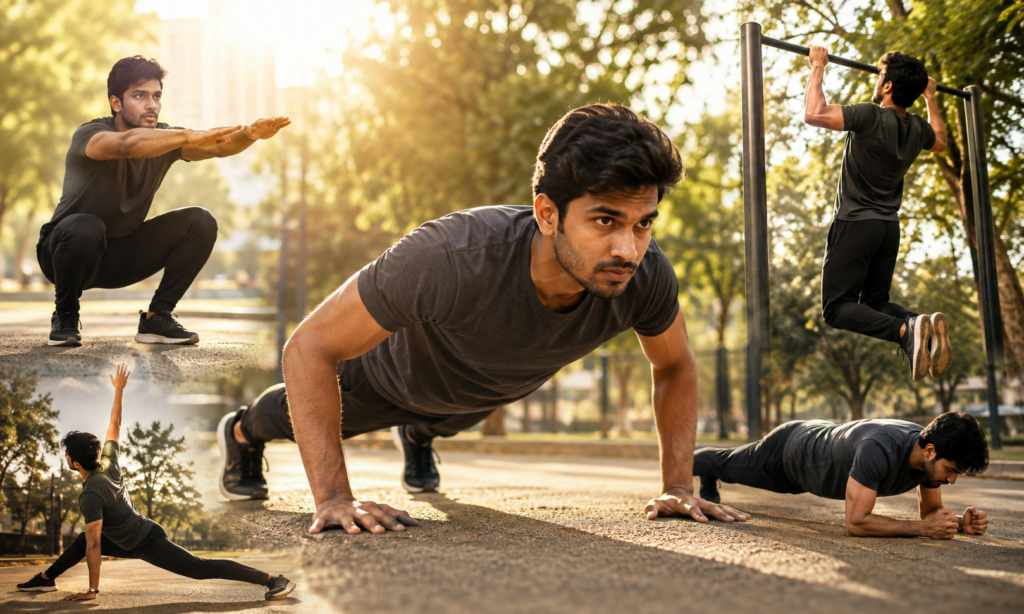
What sets calisthenics apart from general “bodyweight exercise” is the emphasis on control and progression. You’re not just moving – you’re training your body to control that movement through a full range of motion, at a pace and difficulty level you can gradually increase.
Unlike isolated weight training, where you might target a single muscle with a machine, calisthenics almost always involves multiple joints and muscle groups working together. A push-up, for instance, isn’t just a chest exercise. It also demands core stability, shoulder control, and even foot and ankle engagement to keep your body in a straight line.
A Brief History of Calisthenics
The word itself comes from the Greek kalos (beauty) and sthenos (strength). Ancient Greek soldiers and athletes used bodyweight drills to prepare for combat and competition, and the philosophy carried into military training programs for centuries afterward.
In the 19th and 20th centuries, calisthenics became a staple of physical education curricula worldwide, partly because it required no equipment and could be taught to large groups at once. Today, it has evolved into everything from rehabilitation protocols to competitive street workout disciplines, but the underlying principle hasn’t changed – your body is the resistance, and consistency is the method.
How Calisthenics Works
The basic training principle behind calisthenics is the same one that governs all strength training: progressive overload. You gradually increase the demand on your muscles – not necessarily by adding weight, but by changing leverage, range of motion, tempo, or exercise variation.
For example, a wall push-up is easier than a standard push-up because your body weight is distributed differently relative to gravity. As you get stronger, you move to an incline push-up, then a full push-up, then eventually a decline or single-arm variation. The load increases, but the “weight” stays the same – it’s your own body.
This is one of the reasons I often recommend calisthenics-based progressions to patients rehabilitating from injury. You can fine-tune difficulty in small increments, which is much harder to do safely with fixed dumbbells or machines.
Major Benefits of Calisthenics
Strength multi-joint bodyweight movements build genuine, usable strength. A strong bodyweight squat translates directly into standing up from a low chair or lifting a child with better mechanics.
Flexibility Many calisthenics movements take joints through a full range of motion, which over time can improve flexibility in the hips, shoulders, and spine – particularly helpful if you spend most of your day sitting.
Mobility Mobility is different from flexibility; it’s about controlled movement through a range, not just passive stretch. Exercises like lunges and bird dogs train your body to control that range actively, which matters more for daily function than flexibility alone.
Balance Single-leg exercises like step-ups and lunges challenge your balance systems in a way that most machine-based training doesn’t, because you’re forced to stabilize your own body weight.
Coordination Movements like mountain climbers demand your limbs and core work together in a rhythm, which sharpens neuromuscular coordination – useful for sports, but also for simple things like walking on uneven ground.
Core Stability Almost every calisthenics exercise, even ones that don’t look like “ab exercises,” recruits your deep core muscles to stabilize your spine. This is one reason I often use bodyweight drills in back pain rehabilitation.
Heart Health When performed in circuits with minimal rest, calisthenics can elevate your heart rate meaningfully, offering a cardiovascular benefit alongside the strength component.
Weight Management Combining strength and cardiovascular demand means calisthenics can support a healthy body composition when paired with reasonable nutrition – though no exercise program guarantees weight loss on its own.
Functional Fitness Because calisthenics mimics real-world movement patterns – pushing, pulling, squatting, hinging, carrying – the strength you build tends to carry over into daily tasks more directly than isolated gym exercises.
Mental Health Regular movement, especially outdoors or in a routine you can stick to, is consistently associated with reduced stress and improved mood. The sense of progression in calisthenics – going from a wall push-up to a full push-up – can also be genuinely motivating.
Who Can Do Calisthenics?
Most healthy adults, regardless of fitness level, can start a beginner calisthenics routine. Because exercises can be regressed (made easier) or progressed (made harder), it’s genuinely adaptable – a 60-year-old starting their fitness journey and a 25-year-old athlete can both do “push-ups,” just at different variations.
That said, calisthenics is not automatically safe for everyone in every condition. If you have an existing injury, joint pain, recent surgery, a cardiovascular condition, or you’re pregnant, it’s important to get personalized guidance before starting, rather than following a generic online routine.
Beginner-Friendly Exercises
Push-Ups
Targets: Chest, shoulders, triceps, core.
How to perform: Place your hands slightly wider than shoulder-width, keep your body in a straight line from head to heels, and lower your chest toward the floor by bending your elbows to about 45 degrees from your body, then push back up.
Common mistakes: Letting the hips sag or pike upward, flaring the elbows straight out to the sides, and not going through a full range of motion.
Easier variation: Wall push-ups or knee push-ups.
Harder variation: Decline push-ups (feet elevated) or single-arm assisted push-ups.
Squats
Targets: Quadriceps, glutes, hamstrings, core.
How to perform: Stand with feet shoulder-width apart, push your hips back and bend your knees as if sitting into a chair, keeping your chest lifted and knees tracking over your toes, then drive through your heels to stand.
Common mistakes: Letting the knees cave inward, rising onto the toes, and rounding the lower back.
Easier variation: Box or chair squats, using the seat as a depth guide.
Harder variation: Jump squats or single-leg pistol squat progressions.
Lunges
Targets: Quadriceps, glutes, hamstrings, balance.
How to perform: Step forward, lowering your back knee toward the floor while keeping your front knee aligned over your ankle, then push back to standing.
Common mistakes: Letting the front knee travel too far past the toes, losing balance, and taking too short a step.
Easier variation: Static split squats holding onto a wall or chair for balance.
Harder variation: Walking lunges or reverse lunges with a pause at the bottom.
Plank
Targets: Core, shoulders, lower back stability.
How to perform: Rest on your forearms and toes, keeping your body in a straight line from head to heels, engaging your abdominal muscles and glutes.
Common mistakes: Letting the hips sag, holding the breath, and lifting the hips too high.
Easier variation: Knee plank.
Harder variation: Plank with shoulder taps or a weighted vest.
Glute Bridge
Targets: Glutes, hamstrings, lower back.
How to perform: Lie on your back with knees bent and feet flat, then lift your hips by squeezing your glutes until your body forms a straight line from shoulders to knees.
Common mistakes: Overarching the lower back and pushing through the toes instead of the heels.
Easier variation: Small range-of-motion bridges.
Harder variation: Single-leg glute bridges.
Mountain Climbers
Targets: Core, hip flexors, cardiovascular system.
How to perform: Start in a high plank and alternate driving your knees toward your chest at a controlled, steady pace.
Common mistakes: Letting the hips bounce up and down and losing core control as speed increases.
Easier variation: Slow, controlled mountain climbers with a pause between reps.
Harder variation: Faster tempo or adding a cross-body knee drive.
Wall Push-Ups
Targets: Chest, shoulders, triceps (low intensity).
How to perform: Stand facing a wall, place your hands on it at shoulder height, and bend your elbows to bring your chest toward the wall before pushing back.
Common mistakes: Standing too close to the wall, reducing the range of motion.
Easier variation: Standing further from the wall reduces the load further if needed.
Harder variation: Progress to countertop or incline push-ups.
Bird Dog
Targets: Core, lower back, balance.
How to perform: From a hands-and-knees position, extend one arm forward and the opposite leg backward simultaneously, keeping your spine neutral, then return and switch sides.
Common mistakes: Arching the lower back and rushing the movement instead of holding briefly at full extension.
Easier variation: Extend just the arm or just the leg at a time.
Harder variation: Add a pause and a light resistance band around hands and feet.
Dead Bug
Targets: Deep core stabilizers, lower back protection.
How to perform: Lie on your back with arms reaching toward the ceiling and knees bent at 90 degrees, then slowly lower one arm and the opposite leg toward the floor while keeping your lower back pressed down, before returning and switching sides.
Common mistakes: Letting the lower back arch off the floor and moving too quickly to maintain control.
Easier variation: Move only the legs, or only the arms, at first.
Harder variation: Slow the tempo further or extend the range closer to the floor.
Step-Ups
Targets: Quadriceps, glutes, balance, coordination.
How to perform: Using a stable step or low bench, step up fully onto it with one foot, driving through the heel, then step back down with control.
Common mistakes: Pushing off the bottom leg instead of driving through the top leg, and using a step that’s too high initially.
Easier variation: Use a lower step height.
Harder variation: Add a knee drive at the top or hold light weights.
Intermediate Exercises
Once the beginner exercises feel controlled and you can complete them with good form for multiple sets, you can progress to: incline pike push-ups, Bulgarian split squats, side planks with rotation, single-leg glute bridges, inverted rows using a sturdy table, and jump lunges. These add either instability, single-limb loading, or increased range of motion, which raises the demand without needing external weight.
Advanced Calisthenics Moves
Advanced calisthenics includes movements like full pull-ups, dips on parallel bars, pistol squats, handstand push-up progressions, and muscle-ups. These require a solid base of strength, joint control, and often months to years of progressive training. They’re impressive, but they’re not necessary for general fitness or health – many people get excellent results staying in the beginner-to-intermediate range consistently.
Sample Weekly Beginner Routine
A simple way to start is training three non-consecutive days a week, allowing rest days for recovery.
- Day 1 (Full Body): Wall or knee push-ups, box squats, glute bridges, plank, bird dog – 2 sets of 8–12 reps or 15–20 second holds.
- Day 2: Rest or light walking.
- Day 3 (Full Body): Lunges, mountain climbers, dead bug, step-ups, push-ups – 2 sets of 8–12 reps.
- Day 4: Rest.
- Day 5 (Full Body): Repeat Day 1 with slightly higher reps or a harder variation where it feels manageable.
- Weekend: Active recovery – walking, light stretching, or mobility work.
Progression should be gradual. Adding one extra rep per set each week is a reasonable, sustainable pace for most beginners.
Warm-Up Before Calisthenics
A proper warm-up prepares your joints and muscles for the demands ahead and reduces injury risk. Spend five to eight minutes on light cardio, such as brisk walking or marching in place, followed by dynamic movements like leg swings, arm circles, hip circles, and bodyweight squats at a slow, controlled pace. The goal is to raise your heart rate slightly and rehearse the movement patterns you’re about to train.
Cool-Down and Stretching
After training, spend five to ten minutes on static stretching for the muscle groups you worked – hamstrings, quadriceps, chest, and shoulders are common areas of tightness after a calisthenics session. Hold each stretch for 20–30 seconds without bouncing. This supports recovery and can help maintain the flexibility gains from your workout.
Common Mistakes Beginners Make
Many beginners try to progress too quickly, moving to harder exercise variations before mastering the basics. Others skip the warm-up entirely, sacrifice form for higher rep counts, or train the same muscle groups every single day without allowing recovery. Poor breathing patterns – holding your breath during effort – is another common issue that increases unnecessary strain.
Safety Tips
Focus on quality over quantity in every rep. Stop if you feel sharp pain, as opposed to normal muscular fatigue. Progress variations gradually rather than jumping several levels at once. Keep a training log so you can track genuine progress instead of guessing. And allow at least one rest day between sessions targeting the same muscle groups.
Who Should Avoid Certain Exercises
Some calisthenics exercises need modification or should be avoided depending on individual conditions. People with wrist pain or carpal tunnel symptoms may need to modify push-ups onto their fists or forearms. Those with knee issues should be cautious with deep lunges or jump squats until cleared by a professional. Pregnant individuals should avoid exercises involving lying flat on the back for extended periods after the first trimester, and anyone with uncontrolled high blood pressure should avoid holding their breath during static holds like planks. If you’re unsure whether an exercise is appropriate for your specific situation, that’s exactly the kind of question a physiotherapist can help answer.
Calisthenics vs Weight Training
Both approaches build strength, but they differ in a few practical ways.
| Factor | Calisthenics | Weight Training |
| Equipment needed | Minimal to none | Weights, machines, or gym access |
| Progression method | Leverage, range, tempo, variation | Adding external weight |
| Cost | Low | Often requires gym membership or equipment purchase |
| Muscle isolation | Limited, mostly compound movements | Easier to isolate specific muscles |
| Convenience | High – can train anywhere | Location-dependent |
| Ceiling for advanced strength gains | High but technically demanding at advanced levels | Generally easier to progressively overload with added plates |
| Joint-friendliness for beginners | Often gentler, body-weight controlled | Depends on form and load selection |
Neither is universally “better” – the right choice depends on your goals, access to equipment, and any physical limitations you’re working with. Many well-rounded training programs actually combine both.
Can Calisthenics Help in Rehabilitation?
This is a question I get often in clinic, and the honest answer is: it depends on the injury, the stage of healing, and how the exercise is dosed.
Bodyweight exercises can be genuinely valuable in rehabilitation because they’re easy to scale – a wall push-up, a partial-range squat, or an assisted bridge can be adjusted to match exactly where someone is in their recovery. This graded approach is a core principle of physiotherapy: applying just enough load to stimulate healing and strength without overloading a healing tissue.
However, self-directing a rehabilitation program using generic online routines carries real risk. An exercise that’s perfectly safe for a healthy beginner might be entirely inappropriate for someone with a recent ACL repair, a rotator cuff injury, or acute lower back pain. The exercise itself isn’t the problem – the timing, dosage, and technique relative to your specific injury is what matters.
If you’re recovering from a minor strain and have no significant pain, gentle bodyweight movement within a comfortable range is often reasonable. But if you have persistent pain, swelling, reduced range of motion, or you’re recovering from surgery, it’s important to work with a physiotherapist who can build a progression specific to your injury and monitor how your tissue is responding.
Frequently Asked Questions
Yes. Most calisthenics exercises have easier variations, making it one of the more approachable ways to start strength training.
It’s generally better to allow rest days between sessions targeting the same muscle groups, so your body has time to recover and adapt.
No equipment is strictly necessary for beginner routines, though a mat, a sturdy chair, or a pull-up bar can be useful as you progress.
Most people notice improved strength and control within four to six weeks of consistent training, though visible changes in muscle tone can take longer and vary by individual.
It can support weight management as part of a broader approach that includes nutrition and overall activity levels, but no single exercise method guarantees weight loss on its own.
Yes, when exercises are appropriately regressed and progressed gradually. Consulting a physiotherapist first is a reasonable step if there are existing joint concerns.
Calisthenics focuses primarily on building strength through resistance-based bodyweight movements, while yoga emphasizes flexibility, breathing, and mind-body connection, though there’s some overlap in benefits.
It can build meaningful muscle, particularly for beginners and intermediate trainees, though very advanced muscle growth typically requires progressively heavier external loads at some point.
For many people, yes – especially when it includes a mix of pushing, pulling, and lower-body movements. Some may choose to add cardio or weight training for specific goals.
Stop the exercise immediately. Mild muscle fatigue is normal, but sharp, localized, or worsening pain is a signal to pause and consult a physiotherapist rather than pushing through.
Certain core-stabilizing calisthenics exercises, like bird dogs and dead bugs, are commonly used in rehabilitation for back pain, but the specific exercises and progression should be tailored to your condition.
Three non-consecutive days a week is a reasonable starting point, allowing adequate recovery between sessions.
Conclusion
Calisthenics offers a practical, adaptable way to build real strength, improve mobility, and support long-term physical function – without requiring a gym membership or expensive equipment. What makes it particularly valuable from a physiotherapy standpoint is how easily it can be scaled to match where someone actually is, whether that’s a complete beginner, a busy office worker trying to counter hours of sitting, or someone easing back into activity after an injury.
The key is starting appropriately, progressing gradually, and paying attention to how your body responds along the way. If you’re dealing with pain, a past injury, or you’re simply unsure where to start, a conversation with a physiotherapist can help you build a program suited to your specific body rather than a generic one-size-fits-all routine.